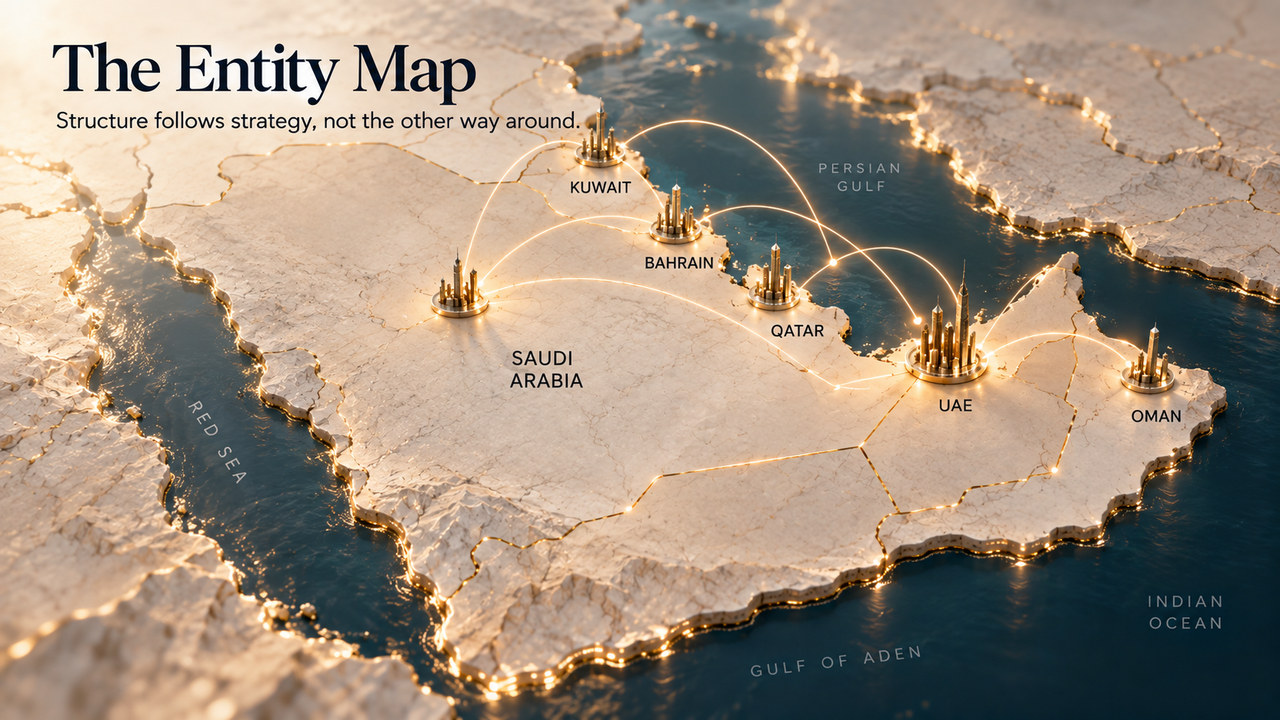
GCC market entry succeeds or fails on financial architecture set before the first invoice: entity structure matched to where revenue will actually come from, a currency and capital allocation position taken once, a transfer pricing posture from day one, subsidiary governance designed for distance, and a regional P&L built in the analytical language head office already trusts. Decided early, this work takes weeks; retrofitted after contracts are signed, the same decisions can take quarters to unwind. The entity map should follow the revenue shape rather than the convenience of the setup process.
The pitch deck gets a company into the GCC. The financial architecture decides whether it stays. Market entry here succeeds or fails on decisions that rarely appear in the expansion plan: which entities you form and where, how you position currency and capital, what transfer pricing posture you take from day one, how the subsidiary is governed at a distance, and whether the regional P&L is one your head office will actually believe. Get those right early and the region compounds for you. Get them wrong and you spend the second year paying for rework instead of growth.
I spent seven years running this problem from the corporate side. As Region CFO for Cisco in the Middle East and Africa, I carried a $1B P&L and full ownership of regional finance. I watched companies arrive with ambition, a market sizing slide, and a freshly hired country manager, then discover that the finance work was the actual project. I also spent those years translating the region to a US head office, and the head office back to the region. Both translations fail more often than either side admits, and most of the failures trace back to architecture that accumulated one expedient decision at a time, with nobody ever sitting down to design it.
What financial architecture does GCC market entry need?
GCC market entry needs five things settled before serious revenue: entity structure across the jurisdictions you will actually sell in, a currency and capital position you take once, a transfer pricing posture that survives scrutiny at both ends, subsidiary governance designed for distance, and a regional P&L built on logic your head office already trusts. Concretely:
- An entity map matched to where revenue will originate, jurisdiction by jurisdiction, channel by channel.
- A currency and capital position taken once: functional currency, committed funding, milestones, and the path cash takes home.
- A transfer pricing posture from the day the entity exists, because intercompany charges begin immediately.
- A governance rhythm built for distance, with decision rights in writing before the first hire.
- A regional P&L constructed in the analytical language head office already uses everywhere else.
Most founders and CFOs I speak with about the region treat these as administrative follow-ons to the commercial plan. Something the setup agent handles. So the sequence gets inverted: hire the general manager, incorporate wherever is fastest, sign the first contracts, then ask finance to make sense of what exists. Every piece of that is fixable. All of it together is expensive.
Structure is cheap before the first invoice and expensive after it.
Entity structure comes before the first invoice
Where and how you incorporate determines who you can invoice, what it costs you in tax and fees, how easily cash leaves, and how credible you look to the customers you came for. Every GCC country writes its own rulebook, and the UAE alone offers a long menu of licensing environments. Free zones give you ownership simplicity and speed. Mainland licensing gives you direct reach into onshore customers, including government, which in this region is often the customer. Saudi Arabia increasingly expects companies that want its revenue to maintain real presence inside the Kingdom. These are commercial questions before they are legal ones, and the commercial answer should drive the legal one.
The failure mode I see most often: a company incorporates where its setup agent found convenient, then wins a contract its license cannot properly serve. Now it is novating agreements, re-registering for VAT, re-papering employment contracts, and explaining to a procurement department why its invoicing entity changed mid-relationship. Weeks of upfront thinking, skipped, become months of remediation. Decide the revenue shape first: who buys, in which country, through which channel, in which currency. Then build the entity map to carry it.
FX and capital: decisions you make once
Most GCC currencies are pegged to the US dollar, which makes the core of the region look currency-safe from headquarters, and mostly it is. The exposure lives at the edges and in the operating detail: the surrounding markets a regional structure often also serves, the mismatch between the currency you bill in and the currency you spend in, and the route cash takes back to the parent. In my Cisco years the regional P&L spanned markets whose currencies moved violently while the Gulf core barely moved at all. A structure that ignores that difference reports numbers nobody can read.
Capital allocation to the region deserves the same discipline you would apply to an acquisition. Decide once, in writing: how much the region gets, against which milestones, in which entity the capital sits, and what triggers more funding or a stop. The alternative is the drip: funding decisions made monthly, each one small, none of them strategic, with head office patience eroding on a schedule nobody agreed to. If your model is consumption-based or pay-as-you-go, this matters twice over, because revenue arrives later than effort and the funding curve has to respect that. I've written separately about the finance behind usage-based pricing.
Transfer pricing belongs in this decision set from day one. The full documentation suite can follow on a sensible schedule, and the detailed structuring is specialist work I refer out. The posture cannot wait: what the regional entity is for, what it earns for which function, and why that logic holds. Retrofitting a rationale years later, under audit, is the expensive version of the same conversation.
A regional P&L head office will believe
Head office believes a regional P&L when it is built on the same analytical logic the company uses everywhere else, with local realities stated as priced assumptions rather than pleas for exemption. That sentence took me years to earn. The region runs on revenue concentration in a handful of large accounts, government cycles, long procurement, and partner-led selling. Head office runs on comparability. When the region explains variances with "this market is different," head office hears "this market is unmanaged." The regional CFO's job is translation in both directions, and I ran regional finance as a decision-support function precisely because the value had migrated from reporting the past to shaping the next decision.
The clearest example from my own tenure: a discount debate on Turkish telecom accounts that resurfaced every quarter, consumed hours, and settled nothing. I ended it by mapping every key operator account in MEA on a BCG growth and profitability matrix. The Turkish accounts landed as Dogs. We redeployed that margin to the Stars and Question Marks, and a debate that had run for quarters ended in one meeting. The accounts were the same accounts, and the data had been available all along. The frame was new, and it was one head office already trusted. That is what the region so rarely does well: it defends its anomalies instead of translating them.
Governance that survives distance
Subsidiary governance works when the operating rhythm is designed for distance: decision rights written down before the first hire, a delegation of authority matrix covering discounts, credit, hiring, and banking, and a monthly cadence that forces the numbers and the narrative to travel together. Distance is the defining condition of a GCC subsidiary reporting into the US or Europe, in hours and in context, and hope is a poor substitute for structure.
The failure mode is structural. The regional general manager becomes the only channel through which head office learns anything. Good news travels fast; bad news waits for the quarter. By the time a problem is visible in the consolidated numbers it is two quarters old. The fix costs little: an independent finance line into the subsidiary from early on, dual signatories on banking, and board minutes that record decisions rather than atmosphere. Companies resist this because it feels like distrust of the local team. In practice it protects them: clear governance is what lets head office say yes quickly, and saying yes quickly is the entire commercial advantage of being present here.
The sequencing that avoids expensive rework
The sequence that avoids rework runs: commercial model first, then the entity structure to carry it, then banking and capital, then people, then systems. Each step constrains the next, which is exactly why the order matters. Banking deserves particular respect; corporate account opening in the region can take longer than incorporation itself, and payroll waits for nobody's compliance review. People come after structure because the first senior finance hire should inherit an architecture, and systems come last because they can only encode decisions that have already been made.
Done in that order, the architecture work is measured in weeks. A three-week diagnostic can settle the entity map, the capital posture, the transfer pricing position, and the governance skeleton before anything is signed. Done in reverse, the same decisions get made anyway, under pressure, one contract at a time, and unwinding them can swallow quarter after quarter. Who does the work matters as much as when. This is senior judgment exercised a few times at the decision points, which is why I've also written about when the Big 4 is the right answer and when it is layering you don't need.
Third Horizon Capital Advisory works with companies entering or scaling in the GCC on exactly this architecture: entity and capital structure framed commercially, a regional P&L built in head office logic, and a governance rhythm that survives distance, delivered through a three-week diagnostic or a monthly advisory retainer as part of strategic financial planning. I lead every engagement personally, and the tax and legal specifics go to specialists who do that work all day.
If the GCC is on your board agenda within the next four quarters, the cheapest hour of the entire program is the one before the first entity is formed. Let's talk.
Kamran Habibollah is the founder of Third Horizon Capital Advisory, a senior financial advisory firm in Dubai serving founders, CEOs, CFOs, and boards across the GCC, the UK, and Europe.

Kamran Habibollah
Founder & Principal, Third Horizon22 years across technology, telecom, and finance at Siemens, Nokia, and Cisco, including seven years as Region CFO for Cisco MEA with a $1B P&L. He advises founders, CEOs, and boards on capital, transactions, and finance leadership from Dubai.
More about Kamran →