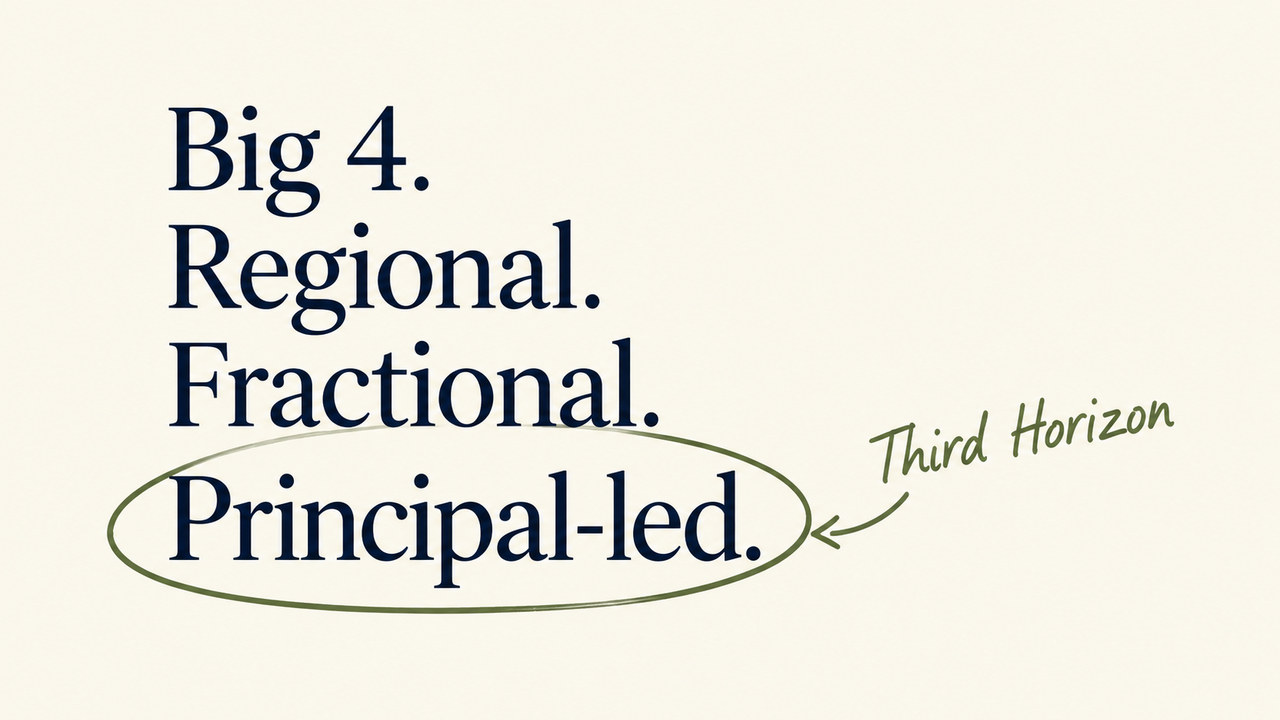
The UAE advisory market has four tiers. Big 4 and strategy firms bring deep benches and institutional weight, with comparable scope priced as a scoped program and delivery led by junior teams under senior sign-off. Regional generalists offer strong networks with variable rigor. Independent fractional CFOs, on monthly retainers, fit earlier-stage companies. Senior single-principal advisors handle complex decisions personally at mid-market scale. The deciding tests: who actually does the work, whether the output is decision-ready, and what support exists after delivery. Big 4 fits regulatory sign-off and global scale; senior independents fit consequential decisions.
The honest answer to the Big 4 versus independent question is that both are right, for different companies at different moments. The UAE market has four working tiers of financial advisory: the Big 4 and strategy firms, regional generalist practices, independent fractional CFOs, and senior single-principal advisors. Which one you should hire comes down to three tests: who exactly will do the work, whether the output will be decision-ready or merely thorough, and what happens after the final deck lands. Settle those three before you look at a fee quote, and the market sorts itself quickly.
A disclosure before the map. I spent 22 years across technology, telecom and finance at Siemens, Nokia and Cisco, seven of them as Region CFO for Cisco MEA with a $1B P&L, the seat where advisory proposals land for approval. Today I operate in the fourth tier described below, mostly for technology, SaaS and platform businesses in Dubai and the wider GCC. So you know exactly where I sit, and you should discount accordingly. I'll try to earn the benefit of the doubt by being genuinely fair to the other three.
Who actually does the work? The question that sorts the market
One question separates the four tiers faster than anything else: name the people who will do the analysis, and tell me what share of the delivered hours belongs to them. At a Big 4 or strategy firm, the partner who wins the engagement supervises it; the models, the research and most of the writing come from capable people a few years into their careers, with quality secured through layers of review. At a regional firm, the answer varies partner by partner. With an independent, the person you're talking to is the person doing the work. At the senior single-principal tier, the same holds at a different altitude of experience.
None of these answers is wrong. The pyramid is exactly what lets a global firm put a large team on the ground at short notice; the solo operator's answer is what keeps judgment consistent from the first call to the final recommendation. What goes wrong is mismatch. A founder buying the partner's brain and receiving a supervised graduate's spreadsheet has overpaid. A multinational buying one person's bandwidth for a multi-country program has underbought.
In advisory, the product is judgment, and judgment does not delegate well.
When is the Big 4 the right answer?
The Big 4 is the right answer when the deliverable needs institutional weight behind it. Regulatory processes, opinions a bank or regulator will rely on, statutory audit, multi-country structuring, transformation programs across a global entity footprint: these need a bench, a methodology and a brand that counterparties accept without argument. If a sovereign fund's diligence team expects a global name on the vendor due diligence report, that expectation is a fact of the deal, and you should meet it.
Price the model honestly, though. Comparable advisory scope at that tier carries a program-sized budget, delivered mostly by junior teams under senior sign-off. That structure is the business model, and at true scale it works. Where mid-market companies get disappointed is cadence and attention: the partner is spread across many clients, deliverables are engineered above all to be defensible, and when the board asks the awkward second-order question, the team often has to go away and come back. If your company needs sign-off, buy the institution. If it needs a decision, keep reading.
What do regional firms do well, and where do they thin out?
Regional advisory firms earn their place on relationships and context. The good ones know the free zones and the mainland licensing regimes, which banks will actually open which accounts, how family groups make decisions, and what a term sheet in this market really means once the pleasantries end. That knowledge is earned locally, it's genuinely valuable, and a global methodology binder doesn't substitute for it. For setup mechanics, local compliance and introductions, a strong regional firm is often the fastest and best-priced route.
Where they thin out is analytical rigor under pressure. Quality varies widely between partners inside the same firm, and work that impressed you on a licensing project can wobble when an international investor stress-tests the revenue model. If you're entering the GCC and the question has moved past setup into how the business should be structured financially, I've written separately about the financial architecture of GCC market entry; the short version is that entity mechanics and financial architecture are different disciplines, and few generalists carry both.
Where does the independent tier hit its ceiling?
Independent fractional CFOs are the right answer for most companies below a certain complexity threshold, and the honest ones will tell you where that threshold sits. Generalist independents in the UAE price well below that, and for an earlier-stage business that's money well spent: clean reporting, cash discipline, a credible runway model, a first fundraise done properly.
The ceiling appears when the questions change character. Multi-entity consolidation across jurisdictions, institutional diligence on a priced round, complex debt, board tension between founders and funds, a market entry that will consume 18 months of cash: these are judgment problems, and the judgment required is formed by having owned comparable decisions at scale. A generalist who keeps a portfolio of SMEs financially healthy has a real skill. It is a different skill from telling a board which expansion structure survives contact with reality, and most generalists know it.
What should you ask any advisor before you sign?
Five questions expose fit faster than any credentials deck.
- Who exactly does the work? Ask for names, and ask what share of the delivered hours belongs to the person selling you the engagement. Watch how directly that gets answered.
- What does decision-ready mean here? Ask how a past deliverable ended. Did it close with a recommendation someone was willing to defend, or with a framework and a menu of options? Analysis that ends a debate is a different product from analysis that documents one.
- What happens after the deck? The board will ask second-order questions and the model will meet reality. Someone has to be there for that. Ask who, and at what cost.
- How is the fee constructed? Hourly billing rewards elapsed time; fixed or capped fees reward reaching the decision. Ask what would move the price, and how often it has moved on past engagements.
- Where are your conflicts? Audit relationships with any party in the deal, success fees tied to closing, referral income from banks or vendors. Good firms answer cleanly; hesitation is data.
Most founders I speak with have never asked the first question in plain words, and the answer, once forced, often reprices the whole engagement. People who sell advisory are excellent at implying seniority. The org chart behind the proposal is where the truth lives.
What does senior single-principal advisory look like?
Senior single-principal advisory means the person with the operating record does the analysis personally, and the engagement is scoped so that this is actually possible. No pyramid, no handoff after the sale, no junior hours billed under a senior implication. The tier exists for companies that have outgrown the generalist level but have no appetite for a seven-figure program: usually businesses between scale-up and institutional, facing a decision whose consequences will outlast the engagement.
The test I hold this tier to comes from my operating years. I've written before that if your finance team is still spending most of its time in the rear-view mirror, you're paying a premium for a commodity; the same test applies to advisors. One example of what the alternative looks like. During my Region CFO years at Cisco, a discount debate on our Turkish telecom accounts kept resurfacing, so I mapped every key MEA operator account on a BCG growth and profitability matrix. The Turkish accounts were Dogs. We redeployed that margin to the Stars and Question Marks, and the debate ended in one meeting. That is the standard the word decision-ready should carry: the analysis closes the question.
Third Horizon Capital Advisory is my practice in this tier: a single-principal advisory based in Dubai, serving clients across the GCC, UK and Europe, primarily technology, telecom, SaaS and platform businesses. I lead every engagement personally; there are no junior staff. The work takes three shapes: a three-week diagnostic, a monthly advisory retainer with a six-month minimum, and fixed-fee projects such as investor and board readiness or commercial and financial architecture. Fees are fixed or capped, never hourly, and every conversation starts under NDA. Just as telling is what I send elsewhere: statutory audit, tax structuring, bookkeeping, full-time interim CFO cover and distressed turnarounds all belong with specialists, and I refer them without hesitation.
Much of this thinking sits inside my board and executive advisory work, where the mandate is a senior counterpart for decisions too consequential to delegate and too specific for a bench. If you're weighing which tier fits your situation, including the cases where the honest answer is a Big 4 partner or a good regional firm, let's talk. The map costs you a conversation.
Kamran Habibollah is the founder of Third Horizon Capital Advisory, a senior financial advisory firm in Dubai serving founders, CEOs, CFOs, and boards across the GCC, the UK, and Europe.

Kamran Habibollah
Founder & Principal, Third Horizon22 years across technology, telecom, and finance at Siemens, Nokia, and Cisco, including seven years as Region CFO for Cisco MEA with a $1B P&L. He advises founders, CEOs, and boards on capital, transactions, and finance leadership from Dubai.
More about Kamran →