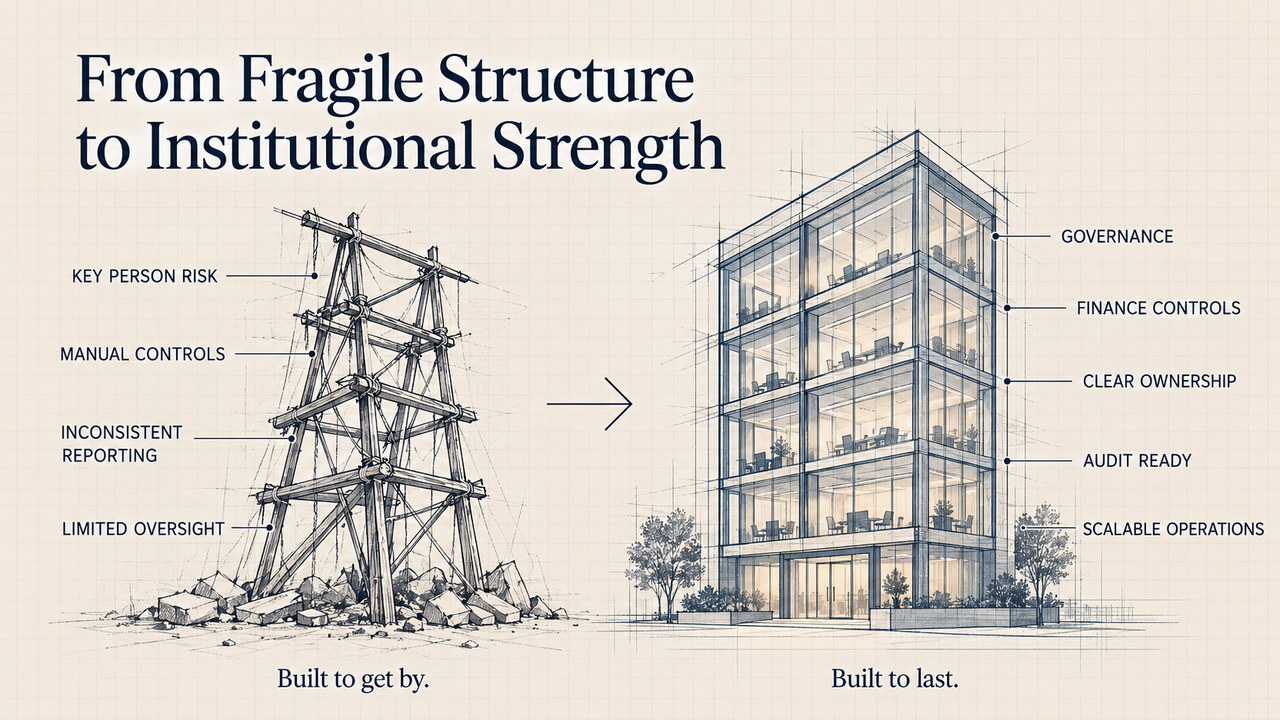
When a private equity fund invests, four things change for the finance function: the monthly close must land on a fixed timetable, reporting shifts from historical description to tracking the deal's value-creation plan, debt covenants impose a monthly compliance discipline, and the board reads every pack. A workable 100-day sequence: weeks one to four establish a clean baseline and close discipline; weeks five to eight build the monthly pack the fund actually uses; weeks nine to fourteen convert the deal model into a value-creation bridge with named owners and an operating cadence that persists beyond the first quarter.
The day a private equity fund appears on your register, your finance function changes jobs. The changes are specific: the monthly close acquires a deadline that binds, reporting gets rebuilt around the value-creation plan the fund underwrote, debt covenants turn your lenders into a monthly audience, and you gain a board that reads every page of the pack. The first hundred days decide whether finance becomes the engine of the investment thesis or the bottleneck the fund learns to route around. The teams that handle it well treat those days as a sequence: four weeks of baseline and close discipline, four weeks building the reporting the fund actually wants, then six weeks wiring the value-creation bridge into an operating cadence that survives quarter two.
I ran regional finance at Cisco for seven years with a $1B P&L, and one conviction survived everything: if your finance team is still spending most of its time in the rear-view mirror, you're paying a premium for a commodity. Nothing tests that conviction like a fund on the register. Private equity is the most demanding customer a finance function will ever have, and also the clearest, because it tells you exactly what it wants and exactly when it wants it.
What changes when private equity invests?
Four things change at once: the cadence, the covenants, the definition of performance, and the audience.
Cadence first. Most founder-led and family-owned businesses close the books when the books are ready. A PE-backed company closes on a timetable, because the fund consolidates your numbers into its own reporting to investors and lenders. Your delay becomes their delay, and they feel it immediately.
Covenants next. If the deal carries debt, the credit agreement now defines EBITDA, net debt, and permitted adjustments with more precision than your management accounts ever did. Someone has to own those definitions, calculate headroom every month, and raise a hand early when the trend turns.
Then performance itself. Before the deal, a good year was a good year. After the deal, performance means progress against the model the fund underwrote: the entry EBITDA, the growth initiatives, the margin assumptions, the exit case. The deal model is now the parent of your budget, and every variance will be read against it.
And the audience. A PE board reads. The deal partner has your numbers inside the fund's own model and will notice a definitional change before you finish explaining it. I've written separately about building board packs that boards actually read; once a fund is on the register, that discipline stops being optional.
The first four weeks: baseline and close discipline
Weeks one to four have a single job: a baseline everyone trusts and a close that lands on schedule. Everything else waits.
Start with the opening balance sheet. Reconcile it to the completion accounts and to the SPA definitions of working capital and net debt, so month one is comparable to the deal model and stays comparable. Align your management EBITDA to the credit agreement's EBITDA and document every bridge item. This sounds like housekeeping. It is also the foundation of every conversation you will have with the fund for the next five years.
Then fix the close. Build a close calendar with an owner for every line, kill the manual journals you can, and set a realistic target: a trusted close inside ten working days now, faster later. Resist the pressure to build dashboards in week two. A beautiful report sitting on an untrusted baseline is decoration.
A note for the deal partner reading this: the fastest way to burn a management team's first quarter is to demand the full reporting suite in week three. Sequence the asks. You'll get better numbers sooner.
Weeks five to eight: reporting the fund can use
By the end of week eight, the fund should receive a monthly pack it can lift straight into its own reporting without rework. That is the test. If an associate at the fund is rebuilding your numbers in a spreadsheet every month, the pack has failed, whatever it looks like.
The core contents are stable across funds:
- Trading performance against budget and against the deal model, on the credit agreement's definitions.
- Cash, actuals plus a rolling 13-week forecast, because cash is where trouble appears first.
- Covenant compliance, calculated monthly with headroom shown, even when certification is quarterly.
- The KPI set the thesis depends on, held stable month to month so the trends are readable.
- Commentary that explains why the numbers moved and what management is doing about it, in a page or less.
Build one set of numbers and cut it three ways: fund, lender, management team. The moment definitions diverge between audiences, you've planted the seed of a very bad meeting. Funds forgive bad months when they see them coming and understand why. What corrodes trust is the surprise.
Funds forgive bad months. They rarely forgive surprises.
Weeks nine to fourteen: the value-creation bridge
The value-creation bridge translates the deal model into named initiatives, each with an owner, a date, and a number. It runs from entry EBITDA to the exit case, and every initiative the fund underwrote gets a line. This is the document that turns the investment thesis from a slide in the fund's committee paper into something management actually runs.
Once the bridge exists, wire it into the operating cadence: a monthly business review that tracks the bridge alongside the P&L, a quarterly reforecast that updates the full-year view, and a board pack that reports thesis progress as prominently as trading. This is decision-support work, and it's where finance earns the seat at the table. As Region CFO at Cisco MEA I ended a recurring discount debate on our Turkish telecom accounts by mapping every key operator account in the region on a growth and profitability matrix. The Turkish accounts were Dogs. We redeployed the margin to the Stars and Question Marks, and the debate ended in one meeting. That is the standard a fund holds finance to: analysis that closes arguments and moves resources.
One more reason to build the bridge early: the exit clock starts at completion. The evidence a buyer's diligence team will demand in three or five years is exactly what this cadence produces every month. I've mapped that path in the 18-month exit-readiness sequence; the companies that find exit easy are the ones that built the machine in the first hundred days.
The mistakes that surface in quarter two
The most common failure is a first quarter built on heroics nobody can repeat. Quarter one runs on adrenaline: the controller works weekends, the pack ships at midnight, everyone performs. Quarter two is where the structure gets tested, and the same cracks appear in company after company:
- A close that depends on one person's spreadsheet, discovered the week that person is on leave.
- Covenant headroom calculated at quarter end, so a tightening trend goes unnoticed for two months.
- A KPI page that drifts away from the thesis because nobody owns the link between them.
- A board pack gaining pages every month until the deal partner stops reading page one.
- The finance hire everyone agreed was needed in week two, still unapproved in week twenty.
Most CFOs I speak with in newly acquired companies describe the same arc: an energizing first hundred days, then a second quarter where the fund's patience shortens just as the team's stamina fades. The fix is structural, and it's cheaper in week one than in week thirty.
Third Horizon Capital Advisory works with PE-backed management teams, and with the partners who back them, on exactly this sequence: the baseline, the reporting architecture, the value-creation bridge, and the operating cadence that holds once the first burst of energy fades. Every engagement is led by me personally, on fixed or capped fees, usually shaped as a three-week diagnostic or a monthly advisory retainer built around strategic financial planning.
If a fund has just arrived on your register, or you're the partner who put it there, let's talk before week one becomes week ten.
Kamran Habibollah is the founder of Third Horizon Capital Advisory, a senior financial advisory firm in Dubai serving founders, CEOs, CFOs, and boards across the GCC, the UK, and Europe.

Kamran Habibollah
Founder & Principal, Third Horizon22 years across technology, telecom, and finance at Siemens, Nokia, and Cisco, including seven years as Region CFO for Cisco MEA with a $1B P&L. He advises founders, CEOs, and boards on capital, transactions, and finance leadership from Dubai.
More about Kamran →