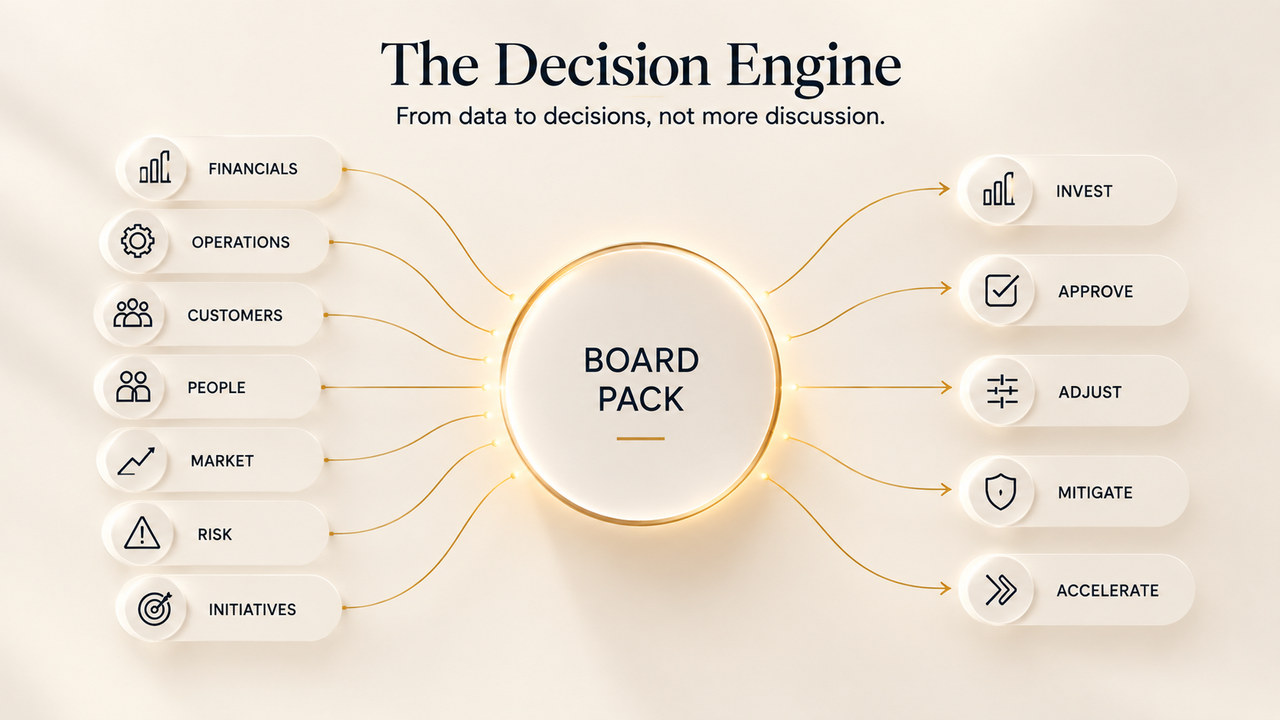
A board pack should answer five questions in order: what happened, why, what is changing ahead, what management will do, and what it needs from the board. Best practice pairs a one-page summary with five to seven stable metrics shown against plan, places bad news first, and moves supporting detail to an appendix. Packs circulate several days before the meeting so time together is spent on decisions rather than narration. Anything that does not support a decision belongs in the appendix or nowhere.
A board pack is decision infrastructure. Most of the ones I read are archives: sixty pages of what already happened, assembled to prove the work was done, circulated too late to change anything. For seven years I was Region CFO for Cisco in the Middle East and Africa, with full ownership of finance for a $1B P&L, and I sat through hundreds of business reviews on both sides of the table. The packs that earned their meeting all did the same thing. They answered five questions, in order: what happened, why it happened, what is changing ahead of us, what management will do about it, and what we need from the board. Everything else either supported one of those answers or got cut.
That sounds simple. It took me years of writing packs, and years more of receiving them, to hold the line on it. The pull toward completeness is constant; the pull toward clarity has to be deliberate.
What should a board pack include?
A board pack should include five things: a one-page summary, five to seven metrics shown against plan, a short narrative built around the five questions, the specific decisions you need from the board, and an appendix that holds everything else.
- Page one. The whole story on a single page: performance against plan, the one issue that worries you most, and the decisions you are asking for.
- The metrics. Five to seven, the same ones every meeting, each shown against plan and prior period.
- The narrative. The five questions answered in plain language, a few pages at most.
- The asks. Decisions to approve, choices to make, doors you need opened.
- The appendix. The supporting detail, for the director who wants to trace a number back to its source.
Order matters as much as content. A director should be able to stop after page one and still vote sensibly on everything you ask.
The five questions every pack answers
Every effective board pack answers the same five questions: what happened, why, what is changing ahead, what we will do, and what we need from you. Each earns its place differently.
What happened is the easy part, and the part most packs overdo. State performance against plan without adjectives. The numbers don't need cheering on.
Why it happened is where finance earns its keep. Separating market movement from execution, pricing from volume, timing from trend: this is analysis, and it is scarce. I've written elsewhere that if your finance team is still spending most of its time in the rear-view mirror, you're paying a premium for a commodity. The why is the first place that premium should convert into insight.
What is changing ahead forces you to publish your leading indicators: pipeline, renewals, hiring, cash. This is the section boards remember.
What we will do turns analysis into commitments with owners and dates. Vague intent reads instantly as no plan.
What we need from the board is the section most packs omit entirely, and it's the reason the meeting exists.
A board pack with no ask is a newsletter, and nobody convenes a board to read a newsletter.
The one-page discipline
The first page should carry the entire story, and writing it should be the hardest hour of your month. If you can't compress the quarter onto one page, the cause is usually upstream: you haven't decided what matters yet. Directors are part-time by design. Preparation time comes in hours, and page one is where those hours get allocated. A strong first page buys the rest of the pack a fair reading. A weak one guarantees the meeting starts with narration.
The discipline compounds under pressure. In a PE-backed business the reporting cadence tightens and the audience gets far more demanding, which is why the pack is one of the first things I address in the first 100 days of a PE-backed finance function. Get page one right early and every subsequent meeting becomes cheaper to prepare and faster to run.
Why bad news goes first
Bad news leads because a board that discovers a problem on page 40 stops trusting pages 1 through 39. Sequencing is a signal. When the miss appears in the first paragraph, named, sized, and paired with a response, the board reads management as being in control of the situation. When it sits buried behind twelve slides of highlights, the board reads management as managing them, and every future pack gets read with a flashlight.
Most founders I speak with worry that leading with the miss will let it dominate the meeting. My experience is the opposite. Addressed early with a plan attached, a miss takes twenty minutes. Discovered late by a director, it takes the whole meeting, and the next one. For a genuine surprise, the pack is already too slow; that conversation happens by phone before anything is circulated. Boards handle bad news far better than most executives expect. Surprise is what erodes trust, and it erodes it fast.
Choosing the five metrics that matter
The right number of metrics in a board pack is five to seven, held stable for at least a year. The test for inclusion is forward-looking: does this number help the board anticipate the next 18 months of cash and growth? Revenue against plan, gross margin, cash and runway, and one or two operational leading indicators specific to your model (net revenue retention for SaaS, utilization for services, pipeline coverage for enterprise sales motions) will cover most businesses. Everything else is appendix material.
The common failure is accretion. A director asks about churn once, and churn joins the pack forever; three years later there are forty metrics and no signal. Cull annually. Change the set only when the business model changes, and say so explicitly when you do, because a metric that vanishes without comment looks like a metric that turned ugly.
Where a finance function sits on the maturity ladder tends to reveal itself here first. Early-stage functions report whatever the systems can produce. Mature ones report what the decision requires, and nothing else.
One clean chart beats forty slides
A single well-chosen visual can end a debate that forty slides of commentary would keep alive for quarters. I watched this happen at Cisco. As Region CFO I inherited a recurring argument about discount levels on our Turkish telecom accounts: every review cycle, the same positions, the same escalations, no resolution. So I mapped every key operator account in the region on a BCG growth and profitability matrix. The Turkish accounts landed as Dogs. Against the whole portfolio, laid out on one chart, the answer stopped being arguable. We redeployed that margin toward the Stars and the Question Marks, and a debate that had survived multiple quarters ended in one meeting.
The chart itself was ordinary; any analyst could have drawn it. It worked because it reframed a series of account-level fights as one portfolio allocation, with a decision rule the whole board could see. That is what board-grade material does. It does the deciding work before the meeting starts, so the meeting can be spent on judgment.
When Third Horizon Capital Advisory takes this on inside a board and executive advisory engagement, the work is concrete: rebuild the pack around the five questions, cut the metric set down to the five to seven that carry signal, and pressure-test the narrative before the meeting where it counts. I lead every engagement personally, and the pack is often the first thing we rebuild, because a better pack pays back at the very next meeting.
If your next board meeting is already on the calendar and the pack still reads like an archive, let's talk.
Kamran Habibollah is the founder of Third Horizon Capital Advisory, a senior financial advisory firm in Dubai serving founders, CEOs, CFOs, and boards across the GCC, the UK, and Europe.

Kamran Habibollah
Founder & Principal, Third Horizon22 years across technology, telecom, and finance at Siemens, Nokia, and Cisco, including seven years as Region CFO for Cisco MEA with a $1B P&L. He advises founders, CEOs, and boards on capital, transactions, and finance leadership from Dubai.
More about Kamran →