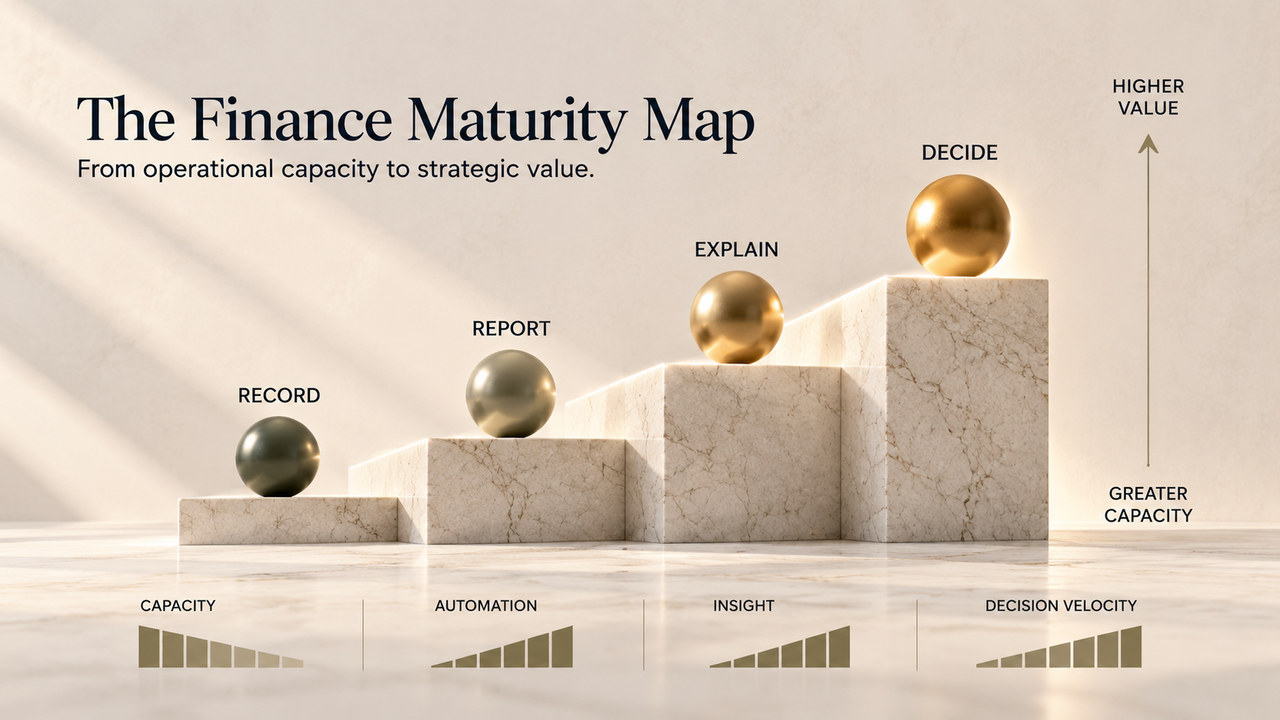
A finance function's maturity can be assessed on a four-rung ladder: Record (bookkeeping and compliance), Report (accurate history delivered on time), Explain (the drivers behind variances), and Decide (forward-looking analysis that changes outcomes). Each rung depends on the one below, yet commercial value concentrates at the top rung while most finance capacity pools in the bottom two. Five questions, covering close reliability, reporting timeliness, speed of insight, forecast use, and decision influence, place a team on the ladder in about ten minutes and reveal which rung to build next.
Every finance function I've led, inherited, or assessed sits on one of four rungs: it records, it reports, it explains, or it helps the business decide. That is the entire maturity model. Record means the books are right and the filings are on time. Report means accurate history, delivered while it's still warm. Explain means someone can tell you why the numbers moved. Decide means finance changes what the company does next. To assess a finance function, place it on that ladder and be honest about the placement, because value concentrates at the top rung while capacity concentrates at the bottom, and the distance between those two facts is where most companies overpay.
How good is your finance function, honestly?
Most leadership teams can't answer that question, because nobody has ever handed them a scale to answer it on. So they grade finance on activity: the close happened, the audit passed, the pack went out. Those are inputs. The only measure that matters is what finance changed about the company's decisions, and by that measure most functions score far lower than their activity suggests.
Most founders I speak with rate their finance function one rung higher than the evidence supports, usually because the bookkeeping is clean and the reports arrive on schedule. Those are the two cheapest things a finance function does. I spent seven years as Region CFO for Cisco in the Middle East and Africa, responsible for finance across a $1B P&L, and the standard I held my own function to was blunt: decision support, or we were an expensive archive. I've said this before and I'll keep saying it: if your finance team is still spending most of their time in the rear-view mirror, you're paying a premium for a commodity. The real value has migrated up the ladder.
The four rungs: record, report, explain, decide
Each rung answers a different question, and each one stands on the rung below it.
- Record: are the books right? Bookkeeping, reconciliations, payroll, filings, compliance. Essential and entirely undifferentiated. Done badly it can sink you; done perfectly it earns you nothing beyond permission to operate.
- Report: what happened? A close that lands on schedule, management accounts that match reality, numbers that hold when someone pushes on them. Accurate history, on time, every month.
- Explain: why did it happen? Margin moved; was it mix, pricing, cost, or timing? Variance drivers, unit economics, cohort behavior. This is where finance starts producing insight rather than paperwork.
- Decide: what should we do? Forecasts that leaders commit resources against, scenarios priced before the board asks for them, pricing and capital allocation shaped by analysis. The rung where finance output changes outcomes.
Two rules govern the ladder. You cannot skip rungs: a Decide-rung recommendation built on Record-rung errors is confident nonsense, and boards eventually find out. And you only occupy a rung when everything below it is solid and boring; the moment your close wobbles, you are back at the bottom, whatever your dashboards say.
Why value concentrates at the top rung
Value concentrates at the top because decisions are the only point where money changes course; every rung below describes money that has already moved. Recording and reporting are commodities with a market price, and that price falls every year as software absorbs more of the work. Judgment about what to do next has no such substitute.
Capacity runs the other way. Walk through most mid-market finance teams and count where the hours go: transaction processing, reconciliation, assembling reports that describe the past. The bulk of the payroll sits on the bottom two rungs while the work the CEO actually needs sits largely unstaffed at the top.
The clearest illustration I can offer is from my own tenure. At Cisco, we had a discount debate on our Turkish telecom accounts that resurfaced every quarter, with the same arguments and no resolution. As Region CFO I had the team map every key operator account in the region on a BCG growth and profitability matrix. The Turkish accounts landed exactly where the data said they would: Dogs. We redeployed the margin we had been burning there to the Stars and the Question Marks, and a debate that had consumed quarters ended in one meeting. Notice the ladder inside that story: clean recorded data, reliable reported history, Explain-rung work on account profitability, then one Decide-rung analysis that moved real money. The top of the ladder did in one meeting what the middle of the ladder had failed to do in years.
A reporting function tells you the score. A decision-support function changes it.
Five questions that place you on the ladder
Ten minutes and five honest answers will place you: your rung is the highest one where the answer is yes and every answer beneath it is also yes.
- Does the close land on schedule, and do the numbers hold? If the close drifts past mid-month or figures change after they've been presented, Record is still under construction.
- Does the board get an accurate pack, on time, that reconciles to the accounts? That is the Report rung. Whether anyone reads it is a separate problem; I've written about board packs boards actually read.
- When margin moves, can finance tell you why within a day? Without commissioning a project. The Explain rung is measured in speed of insight, because slow insight arrives after the decision it should have informed.
- Does a forecast exist that leaders commit resources against? A forecast nobody acts on is a Report-rung artifact wearing Decide-rung clothes.
- Has a finance analysis changed a commercial decision in the last 100 days? A price corrected, a hire redirected, a market entry delayed, a product killed. If nothing comes to mind, you do not have a Decide-rung function, whatever the org chart says.
Most teams that take this test honestly land on Report with one foot reaching for Explain. That placement is normal. It is also the most expensive place to stay, because everything above it is where the return lives.
What moving up one rung changes
One rung changes what your leadership team spends its meetings arguing about.
From Record to Report, the prize is credibility. Banks, investors, and auditors stop treating your numbers as claims to be verified and start treating them as facts to be discussed. Diligence accelerates. The company stops relitigating its own history.
From Report to Explain, the board conversation changes shape. Meetings stop being a guided tour of last quarter and become an interrogation of drivers: why this margin, why this cohort, why this geography. The questions sharpen because the material finally supports sharp questions.
From Explain to Decide, money starts moving earlier. Pricing gets corrected inside the quarter rather than in the postmortem. Resources follow evidence. The company makes roughly the same number of decisions it always made and gets more of them right, and that compounding is worth more than every cost saving the bottom rungs will ever produce. One reallocation of the kind that ended our Turkish discount debate can cover the cost of the entire function for years.
The harder question is how to climb. The bottom rungs are hired: controllers and accountants exist in deep, liquid talent markets. The top rung is senior judgment, which is expensive to employ five days a week before the business can use five days of it. That trade deserves its own treatment, and I've given it one in when to hire a CFO.
Where a structured diagnostic fits
A diagnostic fits when you suspect the honest answers are unflattering and you want the climb sequenced by someone who has run the function at scale. Self-assessment gives you a rung; it rarely gives you the order of operations. The common failure is buying Decide-rung tooling (planning platforms, dashboards) while the Record rung is still soft, which just automates the uncertainty and ships it upstairs faster.
Third Horizon Capital Advisory runs this as a three-week diagnostic: place the function on the ladder against evidence rather than self-report, find the constraint rung, sequence the climb, and put a value on what the next rung is worth to your specific business. I lead every engagement personally, with no junior staff, and fees are fixed or capped; I don't bill hourly. For companies that want top-rung judgment available while their own team consolidates the rungs below, that is the shape of my fractional CFO advisory work.
If you ran the five questions and hesitated on the third, or met the fifth with silence, let's talk.
Kamran Habibollah is the founder of Third Horizon Capital Advisory, a senior financial advisory firm in Dubai serving founders, CEOs, CFOs, and boards across the GCC, the UK, and Europe.

Kamran Habibollah
Founder & Principal, Third Horizon22 years across technology, telecom, and finance at Siemens, Nokia, and Cisco, including seven years as Region CFO for Cisco MEA with a $1B P&L. He advises founders, CEOs, and boards on capital, transactions, and finance leadership from Dubai.
More about Kamran →