
Agentic systems consume compute variably, because the agent chooses its own path through a task. Two runs of the same workflow can cost very different amounts, and aggregated reporting hides that until margin erosion has already scaled. The answer is to treat margin as a design variable: define service profiles with explicit economic boundaries, price to those profiles rather than a flat fee, report margin by workflow type and case complexity, and place checkpoints where economic risk is highest.
Agentic AI changes more than how work gets done. It changes how value and cost actually behave inside a business.
Most teams still approach agents primarily as capability tools. The assumption is that once the technology performs reliably, the economics will take care of themselves through existing reporting and pricing models. But this assumption becomes costly.
The economic reality of agentic workflows
Consider a fintech company that deploys an agent to manage customer onboarding. The agent can pull data from multiple internal systems, run compliance checks, generate documents, and trigger follow-up actions. On the surface, this appears to be a straightforward efficiency improvement.
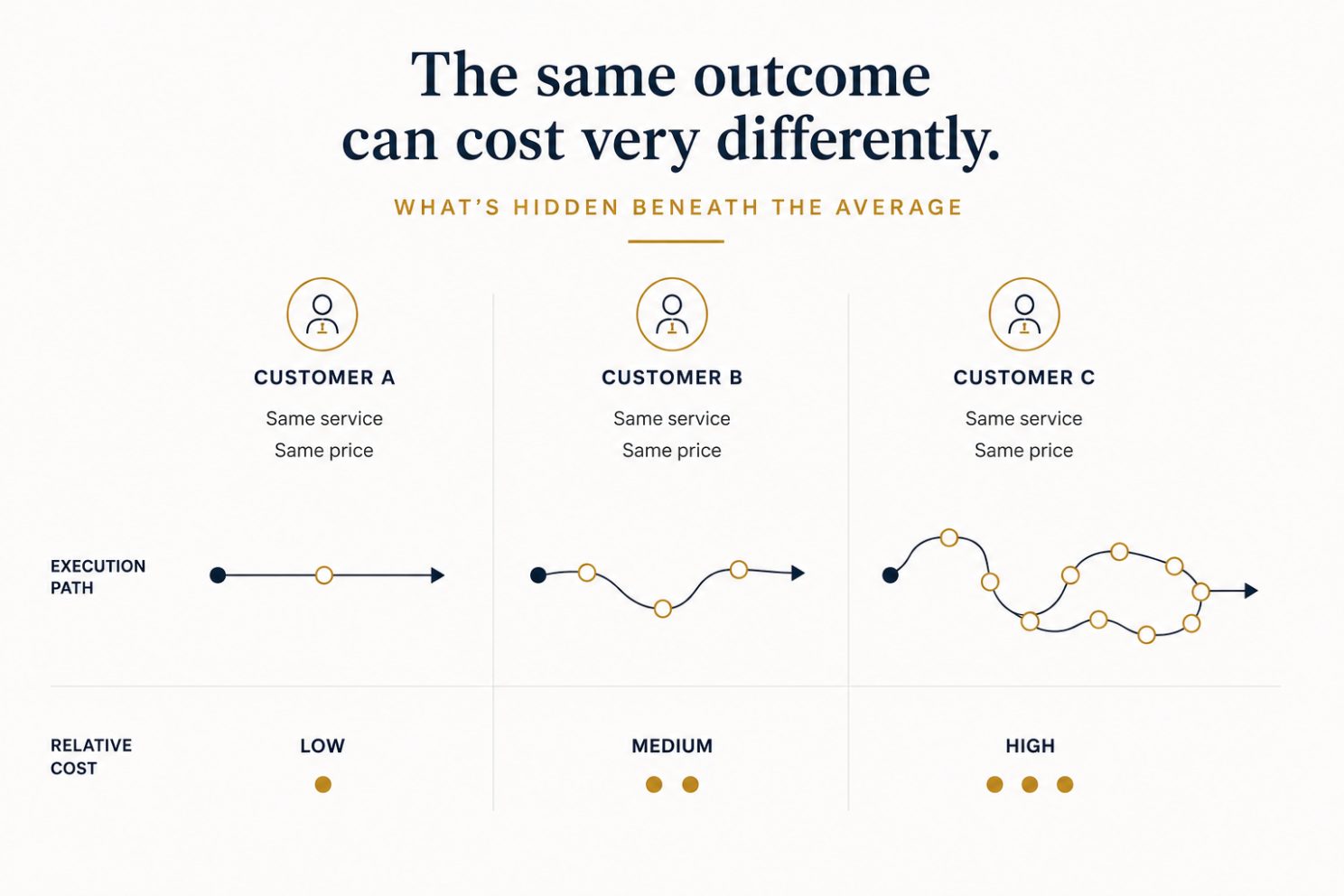
In practice, the agent sometimes follows a short, direct path through the process. Other times, it runs additional verification steps or loops back when confidence levels are borderline. Both paths complete the same task, but they consume very different amounts of compute and time. Traditional reporting shows only the average cost per onboarding. It does not reveal that certain customer types or certain conditions consistently trigger longer, more expensive paths. Over several months, volume increases while margin pressure appears without a clear explanation.
A similar pattern shows up in sales operations. An agent that qualifies leads, prepares proposals, and books meetings can generate highly variable costs depending on how many tools it queries and how many iterations it runs before reaching a decision. The variability comes from the agent’s own reasoning process, not just from differences in customer demand.
These examples highlight a core issue: agentic systems introduce consumption patterns that are more variable and less predictable than most existing financial models assume.
Why traditional approaches create blind spots
Three limitations in current practice make these dynamics difficult to manage.
- Traditional pricing and margin models were built for more stable unit economics. They work reasonably well when consumption is consistent or when human judgment keeps processes within predictable boundaries. They become less reliable when an autonomous system can choose different paths to reach similar outcomes.
- Most reporting remains aggregated. By the time margin erosion appears in monthly or quarterly results, the underlying behavior has already scaled across many interactions. The information arrives too late to influence how the agent operates.
- Capability design and economic design are usually treated as separate workstreams. DevOps teams optimize agents for accuracy, speed, or task completion. The financial consequences are left for reporting to surface later. This separation worked better when automation was narrower and more rule-based. It creates blind spots when agents can chain actions and make intermediate decisions independently.
Treating margin as a design variable
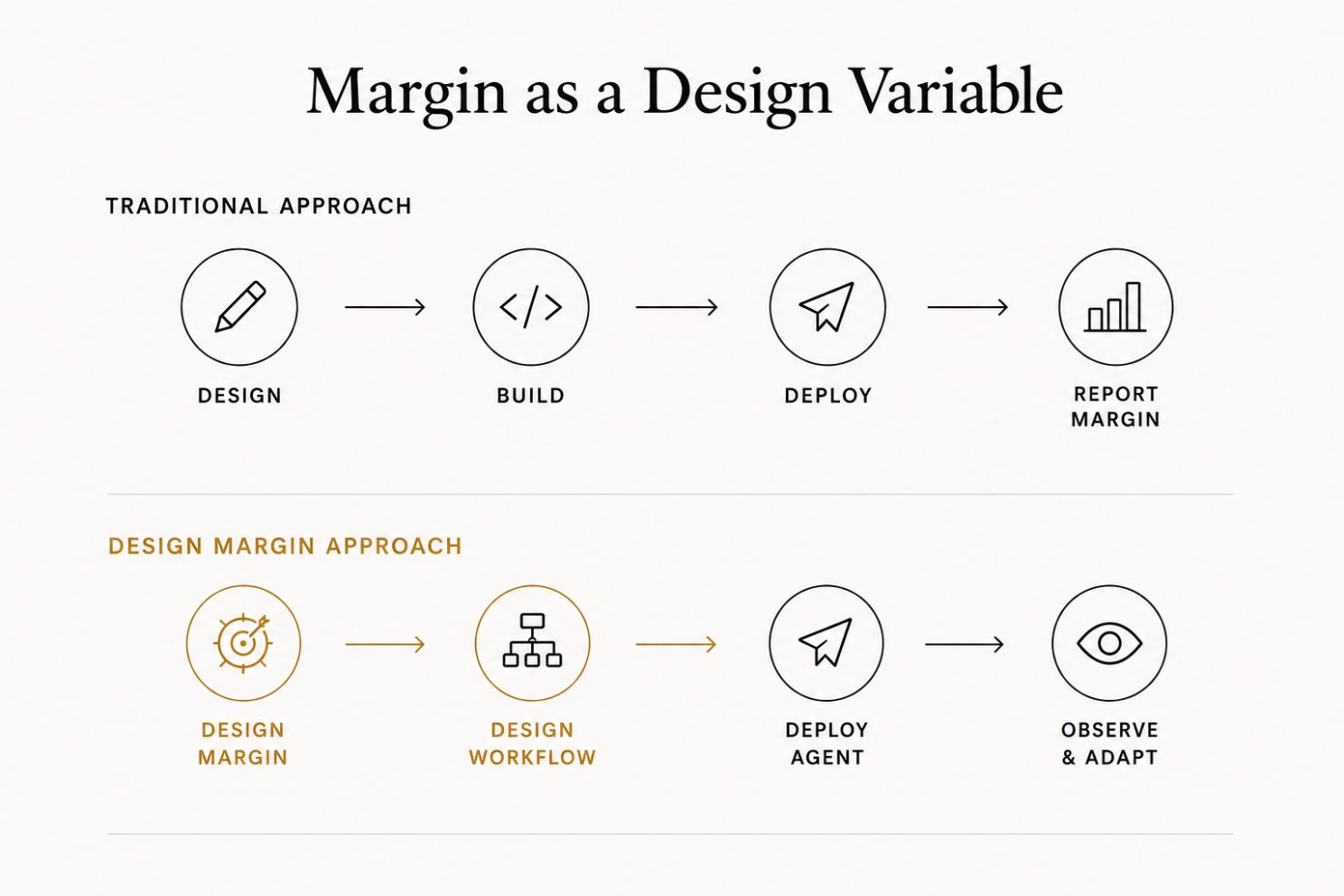
A more effective approach treats margin as something that should be designed into the system from the beginning, rather than measured after deployment.
This means making explicit choices about which outcomes justify variable cost, how value should be attributed across different steps in a workflow, and what signals are needed to guide agent behavior in economically sound directions.
Returning to the onboarding example, the company could define different service profiles with different economic boundaries. Simple cases might run fully autonomously within tight cost limits. More complex cases could include checkpoints where a human reviews the path the agent is taking before it continues. Pricing for customers could then reflect these different profiles instead of applying a single flat fee. The agent still completes the task reliably, but the economic parameters are now intentional design choices instead of unplanned results.
Practical implications
This shift affects several areas of how businesses operate.
Pricing models
Many existing structures assume relatively consistent usage. Agentic workflows often require more flexible models that can accommodate variability while still protecting margin. This can include outcome-based components, usage bands with clear thresholds, or hybrid structures that better align what customers pay with the actual cost of serving them.
Financial visibility
Standard dashboards organized by product or department become less useful. What becomes more valuable is visibility into margin by workflow type, by customer segment, and by the complexity of cases agents handle. The goal is to see the economic impact of different agent behaviors while they are still manageable.
Workflow design
Not every step in a process needs to be fully autonomous. Some steps carry higher economic risk or greater variability. Introducing checkpoints, escalation paths, or selective human oversight at those points is not a retreat from automation. It is a way to protect margin while still gaining the benefits of agent execution where it makes sense.
Governance
Oversight needs to expand beyond functional performance. Leaders require mechanisms to influence the economic behavior of agents, not just their accuracy. This can include cost-aware constraints, budget limits per workflow, or feedback loops that adjust agent behavior based on margin outcomes in addition to task outcomes.
A different starting point
The technology behind agents will continue to advance. The more important question is whether the financial logic that surrounds it advances at the same pace.
Treating margin as a design variable requires teams to make deliberate choices earlier in the process. It does not demand perfect predictions. It does require moving away from the assumption that economic consequences will become clear through conventional reporting after agents are already in production.
Businesses that build this discipline early will have clearer visibility into where value is created and where margin is exposed as agent usage expands. Those that continue to separate capability development from economic design will spend more time managing outcomes they did not anticipate.
Kamran Habibollah is the founder of Third Horizon Capital Advisory, which provides CFO-grade strategic finance insights to founders, CEOs and boards. He spent 20+ years in global technology enterprises running multi-billion-dollar P&Ls.

Kamran Habibollah
Founder & Principal, Third HorizonTwenty years in technology and telecommunications finance, including senior finance leadership at Cisco, across the Middle East, Africa and Europe. He advises founders, CEOs and boards on capital strategy, transactions and investor relations from Dubai.
More about Kamran →